



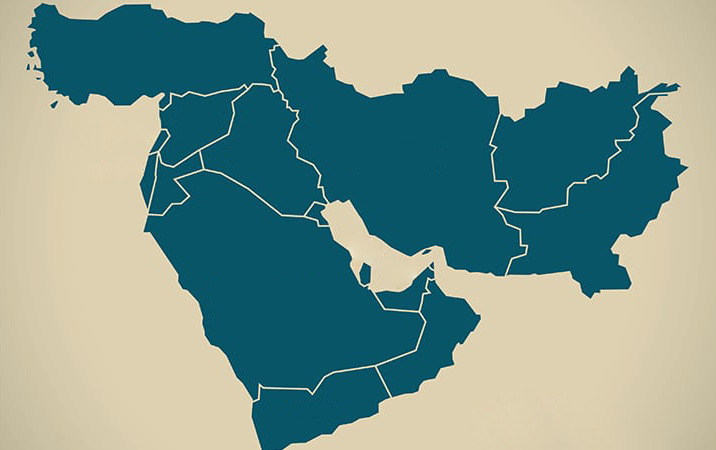
The political engineering of the Middle East from a realistic perspective .
Introduction:
The geography of the Middle East and the renewal of the conflict in it has been the subject of study by many researchers in the humanities and social sciences, because the Middle East was considered the cradle of the three heavenly religions, which was considered a building block and a basic entrance to understand the nature of conflicts and historical conflicts defined by the geography of the region Approaches and variables as an analytical framework through which it is possible to understand the historical process and the factors and determinants controlling the formation of the political and social structure of the Middle East region, especially after the first World War .
Through the above, this study aims to employ the realistic proposition as an approach to analyzing the process of building and shaping the Middle East after the fall of the Ottoman Empire, and this by focusing on political engineering and its role in the formation of the Middle East countries from the perspective of realism. To address the problem of the subject, we tried in this study to ask questions that To what extent did realistic engineering contribute to the reshaping of the Middle East How to understand the political history of the Middle East from a realistic perspective
To answer the previous questions and discuss the problematic of the topic, we tried to divide the study as follows :
- Thesis Weakness The Ottoman Empire
Many researchers believe that there are a number of reasons that came together to end the rule of the Ottoman state and the beginning of the formation of the states of the Middle East, perhaps the most prominent of these reasons is the weakness of the existing economic system in the Ottoman state as a result of the deterioration of the established land system To manage the agricultural sector as the most important economic sector in that period, which is called in Turkish tımar sistemi*[1] This economic system was also considered a source of wealth and an important means of achieving self-sufficiency in the Ottoman state, but the weakness of the state and the multiplicity of fronts of its wars and internal divisions increased the cost of its military campaigns and increased support for the Janissary army, which in turn led to a significant increase in the size of taxes on the Taxes and their resort to the borrowing process, which eventually led to the loss of a large part of their land either in favor of the state or in favor of lenders, as a result of which the phenomenon of internal migration towards cities began to form, many farms were damaged and the Ottoman state inevitably entered As a result of all this, the result was the beginning of the outbreak of numerous riots against the state in certain regions of Anatolia as a result of the failure of the state to abandon the imposed tax policy[2].
On the other hand, although the Ottoman state was able to unite a large number of countries under their imperial banner, but the factor of geography often posed an obstacle and a challenge to the extension of its influence centrally over the entire territory of the Ottoman state, which led to a weakness in imposing control and centralization of the state on some of its remote The beylik system (beylik) is similar to the federal system known at the present time in order to confront the factor of geography and extend its full influence over its subordinate regions, but this was not achieved in the actually planned form only in Istanbul and the heart of Anatolia because of their geographical proximity to the central government, and rarely It reached deep into the communities of the vast territories ruled by the Ottoman Empire
From the social side- The khalduni logic and his perception of the stages of the state seem clear in the analysis of the historical process that the Ottoman State went through, as the stage of predominance and the construction of a strong system of government, which the Ottoman state reached after employing the variable of the nervousness of descent and the nervousness of reason as an actual perspective for the management and This formed a barrier and an obstacle for their successors from the sultans who had a desire to repair the weakness that plagued the pillars of the Ottoman state, as a series of Ottoman sultans and their ministers sought to renew The central administration of the empire through the revitalization of the army and the introduction of modern industrial machinery in the form of the new reform system adopted by Sultan Selim III during his reign from 1789 to 1807, and the reform attempt made during the reign of Sultan Abdul Majid from 1839 to 1876, which was called the era of the era of organizations, through which he tried to simulate the development in European countries through the construction of ships and the beginning of the railway opening project in 1866, in addition to the serious reforms carried out by Sultan Abdul Hamid II in order to restore the prestige of the state and its dominance, but the change of internal and external data was going against their reform theses, especially under The accelerated growth of Western powers[3] .
- Realism as a gateway to understanding the formation of the Middle East
The issue of the weakness of the Ottoman States was the focus of the beginning of the conflict of interests of the major countries such as France, Britain and Russia, and this is through expanding their areas of influence in a way that is in line with the requirements of the Industrial Revolution and its military capabilities, therefore, the realistic perspective gives a clear explanation for the attempt of these three countries to fight a war against the Ottoman state and use them for actual tools based on the idea of increasing armaments, using the logic of alliances and embodying the idea of colonial imperialism In order to increase the size of interest and hegemony, especially since the international policy of that era was based on the logic of force as a tool for imposing hegemony as well as resolving existing international conflicts, which is illustrated by the occupation of Algeria by France in On the other hand, what reinforces the realistic proposition here is the scale of the wars that have brought Russia and the Ottoman state together over the course of a hundred years as a result of Russia's growing ambition to reach warm waters and its desire to dominate the Strait connecting the Black Sea and the Aegean Sea, which resulted in wars between Russia and the 1806-1812, 1828-1829, 1853-1856(Crimean War), up to 1877-1878, given these wars dismantled the logic of the dominance of the Ottoman Empire over the northern region in exchange for this weakness, the Russian geographical area expanded to include more than 15 countries, the strength of which was reflected in the structure of the army of the Russian Empire It included soldiers from Europe, the Caucasus, Asia, Turkestan and Siberia, and thus Russia, with its rugged geography, established a regional power threatening the geopolitical sphere of the Ottoman state at that time[4] .
In another context, both France and Britain were able to use the economic variable as another face to impose their economic dominance, and this is by restricting the Ottoman economy by linking it to financial loans granted to the Ottoman state in the midst of the Crimean War with Russia, which was exploited as a legitimate framework to protect the interests of these countries inside the Ottoman The accumulation of debts in the movement of revolutions and religious and ethnic minorities within the Ottoman state, as well as the attempt to support it in order to secede, which was done by the Russian Empire during its support for Orthodox minorities in the form that resulted in the independence of many Balkan countries from Direct or indirect Ottoman rule, especially Serbia[5]. These realistic determinants served as the actual image of imposing the hegemony of Western countries over the Ottoman state and crystallized the idea of using force and war as the last mechanism to end Ottoman rule .
- The World War as a preliminary given for the beginning of the formation of the Middle East .
The assassination of the Archduke Ferdinand In Sarajevo on June 28, 1914, Austria launched a military campaign against Serbia, which was able in a short time to do the logic of military alliances and common interests as a general indication of the size of the dispute reached by the countries participating in the first World War, where Britain, France and Russia stood in opposition to Austria, Germany and the Ottoman state, here it must be noted that the It was the result of the joint cooperation that brought together the two countries, especially in the field of Economics and military policy, which led to the training of many Ottoman military commanders by the Germans, which created more confidence and formed an elite of the Ottoman military intelligentsia In addition, the issue of the Ottoman state's realization of the expansionist ambitions of both Russia from the north, France and Britain from the West as an external challenge threatening the continuity of the state led to its alliance with Germany with a developed military industry, as well as the embodiment of the magnitude of mutual interests, especially in the axis of the agreement supporting the Baghdad– Germany railway project, which Britain, as a previous endeavor, is therefore a setback for its diplomacy [6]. All this ultimately led to the approval of the Ottoman Empire to enter the war on the side of Germany by assigning command to Enver Pasha on August 2, 1914 in a desire to form an Ottoman - German alliance to strike Russia, and this alliance was activated on October 29, 1914 after the Ottoman fleet bombed several Russian ports on the Black Sea to end the first World War Germany and its allies, including the Ottoman Empire, and the actual beginning of the division of the Ottoman Empire into the states of the Middle East led by France and Britain, while the independent republic of Turkey emerged out of the Ottoman defeat[7].
- TheThe architecture of realism for the Middle East
In the midst of this proposal, we should refer to political engineering as a new proposal that has been advocated for adoption in recent years in order to help emerging democracies or transitional countries that were experiencing a phase of conflict to build political systems, institutions and electoral systems with a sustainable and regular democratic orientation within divided societies[8]. But in this study, based on the realistic perception experienced by all countries at the end of the eighteenth and nineteenth centuries, we mean the prevailing perspective in the formation of states in the post-World War I period, so that this proposition was employed as a tool in the formation of states and systems of government serving the logic of domination and their balances at that A Western perspective based on the use of political, economic, social and even geographical dimensions to formulate and form patterns of states and systems of government in line with the perspective of international politics of that period .
In this regard, the end of the first World War led to a reformulation of the logic of the geopolitics of the Middle East, where Iraq, Egypt and many Hejaz countries were controlled by Britain, while France controlled Syria and Lebanon, so that Britain basically tried to employ a set of socio-cultural variables inherited from the Ottoman rule in minority management based on To the point of reference, which sees that nationalism is formed and takes root after States and governments are established, which in turn feed these feelings to preserve its entity within its territorial borders[9] . In the midst of this proposal, at the beginning of the twentieth century, there was a significant growth of three nationalities in the Middle East represented by Arab nationalism, Turkish nationalism, in addition to Jewish nationalism, especially since the roots of nationalism emanating from the womb of Western Europe found a suitable environment for it in the Ottoman Empire, which includes diverse ethnicities and cultures, the issue of identity and Based on the element of religion and place as one of the key factors in the formation of collective identity[10]. This was exploited by the major powers as a tool for the implementation of their partition projects, where both movements and minorities belonging to the Ottoman state were supported and encouraged to adopt the National proposition as an alternative basis for forming separate states from the Ottoman administration. From this point of view, Britain supported the Arab nationalist movements in the Middle East with linguistic and religious reference as a composite basis for the collective identity of the peoples of the Middle East, linking it with the noble lineage as another basis combining the two identities and using it as a means of forming states in the Middle East, similar to the English support for the revolution of Sharif Hussein Therefore, the limits of this idea were sufficient to manage the Middle East Region and capable of causing a big rift between the prominent nationalities in the Middle East in the form of Arab nationalism And Turkish nationalism, especially at the level of the head of the affiliates of the young Turkey Association, in a way that ensures the functioning of the British scheme, which was aimed at weakening the structure of the boredom system on which the Ottoman state is based in the management of the minorities under its rule and thus facilitating the process of dismantling it, and on the other hand, ensuring that the Ottoman state In the same context, the new division of the Middle East was able to put sensitive points in the geography of the region through the deliberate west to put a buffer zone between Turkey, the Levant and Iraq through the division of the Kurds ( Kurdish nationalism) on the conflicting geographical borders of Turkey, Iraq and Syria instead of forming their own state in order to prevent any rapprochement between the Arab and Turkish nationalities . In exchange for this, Jewish nationalism would be recognized by trying to establish a new homeland for their nationalism in the Palestine region to strike any religious attachment in the region, especially after the failure of the project to support Sharif Hussein based on the idea of strengthening the Arab Religious and national identity as a framework from which to derive the legitimacy of the Had it not been for the British support, Sharif Hussein's movement would have been crushed by the beginning of 1917, indicating that his career was over[11]. This marks the beginning of the use of a new mechanism based on the idea of strengthening the logic of tribalism and predominance as another basis in the recycling of political systems in the Middle East in order to ensure the management of conflict and crises that serve the dominant Western interests, especially since it is impossible to separate the given religion and tribe from the general framework Consensus preserves the balances and interests of the major powers by concluding a secret agreement called the Sykes agreement- The most important point that can be referred to in this agreement is the idea of an alternative homeland for Jews under international auspices only, we believe, although the process of establishing a homeland for Jews in a holy area in Palestine in its apparent form is the formation of an alternative homeland for Jewish nationalism as a result of the pressures of some However, apart from this, the agreement carried a hidden content, which was the establishment of a state alien to the general pattern of the geography of the Middle East in order to ensure that the Muslim-majority Arab nationalism would not unite within the framework of a state As well as ensuring the unity of the peoples of the region towards the liberation of this holy region instead of wading in and objecting to the idea of new divisions of the Middle East. Through the above, we can determine the axis of realistic geometry and its role in the process of dividing the Middle East through the following scheme:
Source: prepared by the researcher .
Conclusion of the
Through the above, the starting points of political engineering from a realistic perspective were based at the beginning on the consecration of the logic of economic domination to serve the Western interest through the establishment of direct and indirect economic relations in which all efforts were invested to reach the process of enabling the European economy within the borders of the Ottoman state and then This facilitated the process of winning the war and the beginning of the project of rebuilding the Middle East by employing all religious, ethnic and national variables up to the formation of dissonant political units Facilitates the process of managing the Middle East crises in a way that achieves interest and dominance. Therefore, the Western interest has not thrown all its eggs into one basket, as the West believes, the process of engineering the countries of the Middle East is a complex process in which all variables have combined to make us a historical postulate for us . From this we conclude that understanding the general analytical data of this reality enables us to explain many of the crises that the Middle East region has gone through and is going through .
This post has already been read 1002 times!